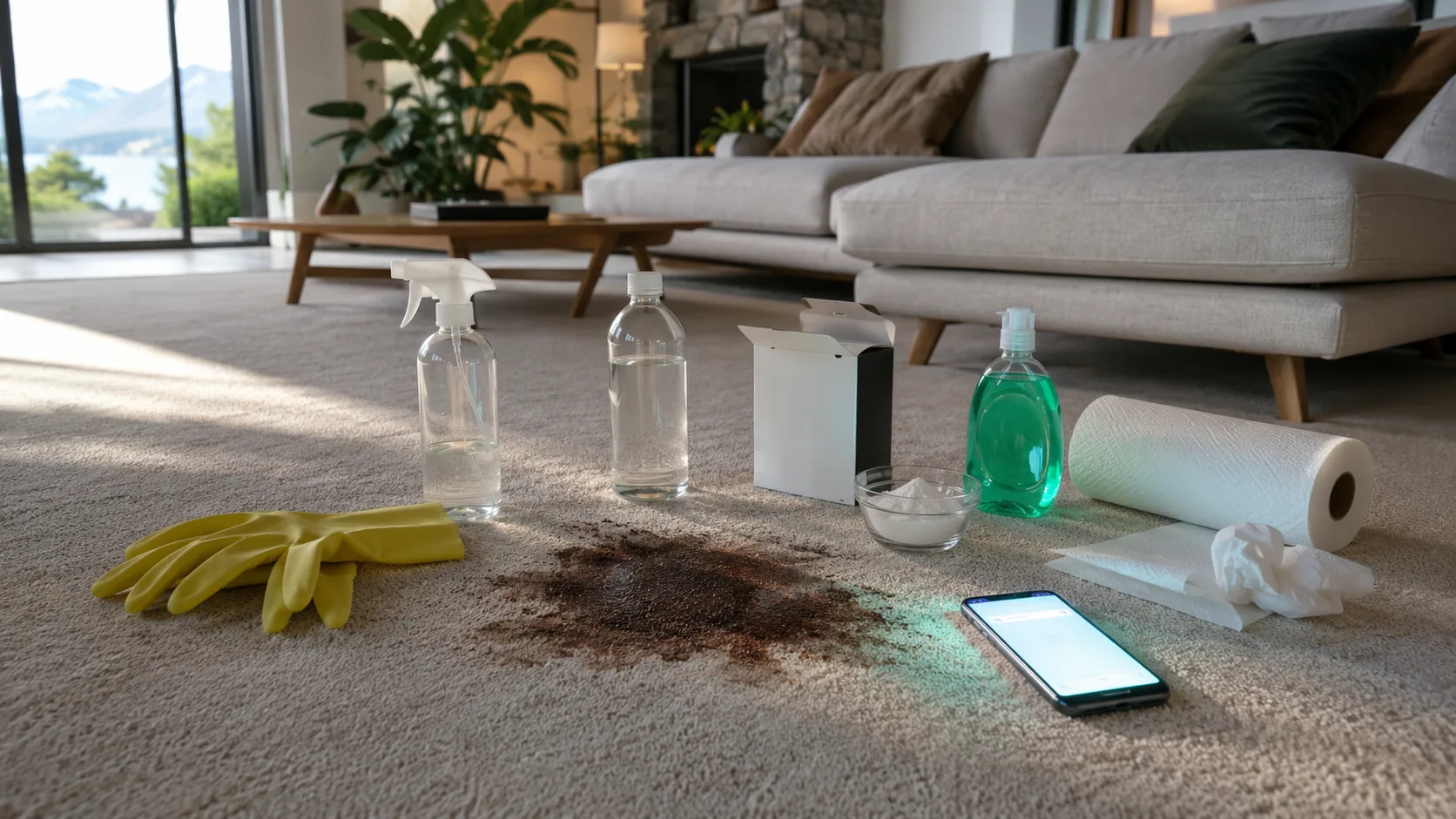
Let us have a friendly but serious conversation.
Please stop asking Uncle Google what to put on your carpet, mattress, rug, sofa, or upholstery stain.
Please.
We are begging professionally.
Because by the time we arrive, the original stain is often no longer the main problem.
The original stain was just the beginning.
The real problem is the chemical fruit salad that has been created afterwards.
A bit of vinegar. A bit of baking soda. A splash of dishwashing liquid. Some laundry powder. Maybe a supermarket stain remover. Maybe a bit of bleach, because apparently we are now conducting an experiment.
Then maybe more vinegar, because the first round did not work. Then more baking soda, because the internet said it would neutralise the odour.
Then it all dries into the carpet, mattress, or sofa, and suddenly the stain is no longer just coffee, urine, wine, blood, makeup, cordial, or mystery liquid.
Now it is coffee plus vinegar plus baking soda plus detergent plus residue plus over-wetting plus panic.
Beautiful.
The Original Spill Is Usually Not the Disaster
Here is the part people need to understand.
Most fresh spills are manageable.
A fresh stain is usually not the disaster.
A fresh urine accident, red drink spill, coffee spill, wine spill, food stain, or mattress accident can often be treated properly if it is handled the right way from the start.
But that is not usually what happens.
What usually happens is this: someone sees the stain, they panic, they search online, they find a simple home remedy, they apply it generously, it does not work, they apply more, then they scrub, then they rinse, then they add something else, then they put a towel over it, then they forget about it for two days.
Then the stain comes back, bigger, darker, smellier, and now with a suspicious crunchy texture.
That is when we get the call.
And then the conversation starts with: it was just a small stain.
Yes. It was. Before the home chemistry festival began.
Baking Soda Is Not a Magic Carpet Doctor
Baking soda has somehow become the superhero of the internet.
Smelly carpet? Baking soda. Mattress stain? Baking soda. Pet urine? Baking soda. Wine spill? Baking soda. Probably financial advice too, if you scroll far enough.
But here is the reality: baking soda is not a professional urine treatment. It is not a stain removal system. It is not a deep decontamination method. It does not magically extract contamination from carpet backing, underlay, mattress foam, or upholstery layers.
What it often does is leave powdery residue deep in the fibres.
Then that residue mixes with moisture, urine, detergent, dirt, and whatever else has been added.
Then it becomes sticky, chalky, crusty, or difficult to rinse out.
Then we have to remove not only the original stain, but also the baking soda archaeology buried inside the carpet.
Wonderful.
Vinegar Is Not Always Your Friend
Vinegar is another favourite.
The internet loves vinegar.
Vinegar for cleaning. Vinegar for odour. Vinegar for carpet. Vinegar for upholstery. Vinegar for mattress stains. Vinegar for basically everything except maybe replacing the engine in your car, although someone has probably suggested that too.
Yes, vinegar has some uses.
No, that does not mean you should pour it onto every stain you see.
On carpets, mattresses, rugs, and upholstery, vinegar can create problems. It can affect dyes. It can react with other chemicals. It can leave odour. It can change the pH of the material. It can make some stains harder to treat.
And when vinegar is mixed with baking soda, people often think they are doing something very scientific because it bubbles.
The bubbling looks impressive. Very dramatic. Very educational.
Unfortunately, dramatic bubbling does not mean stain removal.
Sometimes it just means you have created wet salty residue inside your carpet.
Congratulations, Professor.
Dishwashing Liquid Is for Dishes
Dishwashing liquid belongs in the kitchen sink.
Not deep inside your carpet. Not inside your mattress. Not soaked into your sofa.
Dishwashing liquid is designed to foam, cut grease, and stay active in water. When people use it on carpet or upholstery, they often use too much. Then it becomes difficult to rinse out properly.
The result?
Sticky residue. Rapid re-soiling. Brown marks. Foaming during professional extraction. Stains that spread. Fibres that feel wrong.
And sometimes a stain that looked small at first becomes a large, dull, sticky patch that attracts dirt like it has a business plan.
Then people say, the stain came back.
Sometimes the stain did come back. Sometimes it is now detergent residue grabbing soil from every footstep.
Either way, now we have two problems.
Please Do Not Use Bleach
This one should not need to be said. But apparently it does.
Please do not put bleach on your carpet, mattress, rug, sofa, or upholstery.
Bleach does not clean colour. Bleach removes colour. Permanently.
If you put bleach on a carpet and it turns orange, yellow, white, pink, or some exciting new shade of regret, that is not a stain anymore.
That is damage.
We cannot remove missing colour. We cannot extract a bleach mark. We cannot rinse out a colour that no longer exists.
At that point, the conversation changes from stain removal to repair, dye correction, patching, replacement, or learning to love your new modern abstract carpet design.
The Social Media Cleaning Hack Problem
A lot of online cleaning advice is created for views, not results.
A video needs to look satisfying. Bubbles look satisfying. Foam looks satisfying. Pouring five products onto a stain looks satisfying. Scrubbing aggressively while upbeat music plays looks satisfying.
But real stain removal is not about looking satisfying on a 20-second video.
It is about understanding fibres, dyes, chemistry, pH, moisture, residue, backing material, drying behaviour, contamination depth, and the type of stain.
That does not go viral as easily.
Apply the correct chemistry after identifying the fibre and contamination type, avoid over-wetting, neutralise where required, extract properly, and dry correctly is not quite as exciting as this one household trick removes everything.
But it is a lot closer to reality.
Urine Is Not Fixed With Perfume and Powder
Pet urine and human urine are especially badly handled by home remedies.
People pour vinegar on it. Then baking soda. Then enzyme spray from the supermarket. Then deodoriser. Then carpet foam. Then more baking soda. Then they wait.
Then the room smells okay for a day or two.
Then the smell comes back.
Of course it comes back.
The source was never properly treated.
Urine can travel deep into carpet backing, underlay, subfloor, mattress foam, and upholstery layers. The visible yellow stain on top may only be the tip of the problem.
When the weather gets warmer or humidity rises, old urine contamination can reactivate. That is when the smell returns.
Not because your house is haunted. Not because the carpet is just old. Because the urine is still there.
Now mixed with vinegar, baking soda, detergent, deodoriser, and disappointment.
Scrubbing Usually Makes It Worse
Another classic mistake is aggressive scrubbing.
People see a stain and attack it like it owes them money.
Hard brush. Towel. Circular motion. More pressure. More product. More panic.
The problem is that scrubbing can distort fibres, spread the stain, push contamination deeper, and damage the texture of carpet or fabric.
With upholstery and mattresses, it can also create watermarks, fibre distortion, and visible clean marks.
Sometimes we arrive and the stain itself is treatable, but the physical damage from scrubbing is not.
The stain may improve. The bald, fuzzy, distorted patch where someone performed a carpet exorcism may remain.
The Real Problem Is the Aftermath
This is the main point.
Most of the time, the initial spill is not the biggest problem. The aftermath is.
The vinegar. The baking soda. The detergent. The supermarket spray. The enzyme product used incorrectly. The bleach. The laundry powder. The disinfectant. The steam mop. The over-wetting. The scrubbing.
The I saw it on Facebook technique. The my auntie said this always works method. The I just used a little bit statement, which usually means half the bottle.
That is what turns a normal stain removal job into a restoration job.
Now we are not just removing the original stain.
We are correcting everything that happened after it.
And yes, that costs more.
Because now we have to deal with the stain, the residue, the chemical reactions, the odour, the fibre damage risk, and sometimes the fact that the stain has been permanently set by previous attempts.
What Should You Do Instead?
Here is the safe version.
Blot the spill gently with a clean white towel.
Do not scrub. Do not pour random products on it. Do not soak it. Do not use bleach. Do not create a volcano with vinegar and baking soda. Do not turn the carpet into a science fair project.
Remove as much liquid as you can by blotting.
Then call someone who actually deals with difficult stains professionally.
That is it.
Very boring. Very sensible. Very effective.
Cheap Advice Can Become Expensive
The internet is full of free advice.
Unfortunately, free advice can become very expensive when it ruins a $4,000 mattress, a $6,000 sofa, or carpet that costs more to replace than people realise.
We have seen hundreds of carpets, mattresses, furniture items, rugs, and upholstery pieces made worse by home remedies.
Not one or two. Hundreds.
And almost always, the story is the same.
The customer was trying to save money.
Completely understandable.
Nobody wants to pay for professional stain removal if they think they can fix it with something from the pantry.
But when the home remedy fails, the job becomes harder, more expensive, and sometimes impossible to fully correct.
That is the part Uncle Google does not mention.
Professional Stain Removal Is Not Guesswork
At TrueRevive Xpert, we do not treat every stain the same way.
Because stains are not the same.
Carpet fibres are different. Mattress materials are different. Upholstery fabrics are different. Wool is different from nylon. Synthetic fibres behave differently from natural fibres.
Urine is different from coffee. Red dye is different from rust. Blood is different from body oil. Flood contamination is different from a drink spill.
That is why one magical household solution for everything is nonsense.
Proper stain removal is a process.
It requires assessment, testing, correct chemistry, controlled application, extraction, neutralising when needed, drying control, and experience.
Sometimes the work is simple. Sometimes it is not.
But guessing is how stains become permanent.
Final Message From Your Carpet
Your carpet would like to say something.
Please stop pouring things on me.
Your mattress would also like to add: please stop rubbing baking soda into my internal organs.
And your sofa would like to quietly ask: why was I attacked with dishwashing liquid and vinegar at 11 p.m. after a Facebook video?
Fair questions.
So next time something spills, leaks, smells, stains, or glows in a colour that nature never intended, take a breath.
Do not panic. Do not ask Uncle Google for a potion. Do not raid the kitchen cupboard. Do not mix powders and liquids like a medieval wizard.
Blot it gently. Leave it alone. Call a professional.
Because the original stain is usually fixable.
The fruit salad you create afterwards? That is where the real trouble begins.
Need Professional Help?
Our team is ready to tackle any carpet challenge. Request a quote or give us a call.